
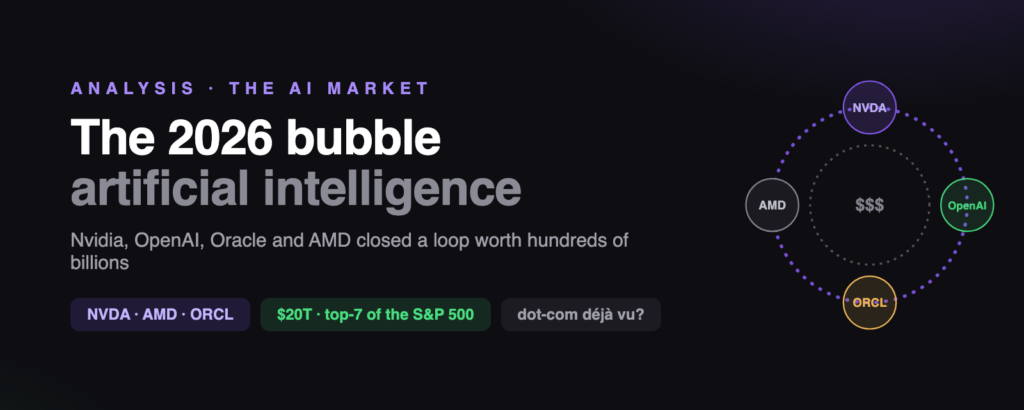
Nvidia, OpenAI, Oracle, and AMD: how a handful of companies are closing the loop on AI investment
Today’s artificial intelligence boom is not just a technological revolution — it is an intricate web of interdependent deals between giants that compete with each other and prop each other up at the same time.
Right now Nvidia plans to invest in OpenAI, which in turn buys cloud capacity from Oracle. Oracle buys chips from Nvidia, which holds a stake in CoreWeave — a company that provides AI infrastructure to that same OpenAI.
The result is a kind of investment ring, in which money and computing power circulate among the same participants.

A closed ecosystem of big players
The artificial intelligence market is developing at breakneck speed, and only a handful of companies remain at the frontier. They invest in one another to secure access to colossal resources — both capital and computing power.
These deals are already valued at hundreds of billions of dollars, pushing US stock prices sharply higher and helping drive the indices to all-time highs.
But such concentration of capital in so few hands raises questions. Experts warn: when money circulates inside a single ecosystem, it can create an illusion of growth rather than real profitability.
Risks of overheating and a “bubble”
Analysts at Oxford Economics point to parallels with the dot-com era. Back then, excessive investment in technology companies led to a market crash in the early 2000s.
“The experience of a quarter-century ago will not necessarily repeat itself, but the scale of current investment already points to significant risks,” Oxford Economics analysts note in their research.
If AI efficiency and performance turn out not to live up to expectations, a sharp correction in tech-giant stocks is possible — one that would hit the entire US economy.
The new deal: OpenAI and AMD
The latest link in this chain appeared only recently. OpenAI, the developer of ChatGPT, announced a partnership with AMD — a maker of artificial intelligence chips.
Under the terms of the deal, OpenAI will purchase AMD processors (the amount is not disclosed) and in return will receive the right to a stake of up to 10% in the semiconductor company.
Less than a month earlier, Nvidia had pledged to invest up to $100 billion in OpenAI itself.
“Excited to partner with AMD and use their chips to serve our users!” OpenAI chief Sam Altman wrote on X (formerly Twitter).
Curiously, AMD and Nvidia are direct competitors, which makes these financial entanglements all the more paradoxical. Nvidia representatives declined to comment on whether the funds invested in OpenAI would indirectly go toward buying their rival’s chips.
The doomsday scenario: will AI repeat the dot-com bubble?
Some analysts look at the Nvidia and OpenAI deal and feel déjà vu. All of this has happened before — in the late 1990s, as the dot-com bubble was inflating.
Back then, in March 2000, the Nasdaq Composite index collapsed by 77%, wiping out billions of dollars of technology companies’ market value. It took 15 years for the market to return to its previous highs.

History may repeat itself
“There is a healthy part and an unhealthy part of the AI ecosystem,” says Gil Luria, managing director at DA Davidson, who specializes in technology.
The unhealthy part, he says, is the “related-party transactions,” where the same companies invest in one another, creating a closed loop that artificially props up their valuations.
If investors decide the ties between the giants are getting too close, the market could “cool off.” On Wall Street that usually goes by a simpler name: a burst bubble.
Altman: “This is a normal cycle”
OpenAI chief Sam Altman is trying to cool down talk of an impending collapse.
He argues that ups and downs are a natural part of any industry’s evolution:
“Between the ten years we have already been at this and the decades still ahead, there will be ups and downs. People will invest too much — and lose money. People will invest too little — and miss out on returns”
So. Much. Money.
Despite all the talk of a “bubble,” the appetite for AI investment remains insatiable.
For now, the risks are outweighed by the prospect of colossal profits — and that is exactly what Wall Street lives and breathes.
Many investors today are not asking whether the current pace of AI progress is real, but something else: can companies start earning fast enough to justify the injections of hundreds of billions.
“For this massive experiment not to end in disaster, OpenAI and its partners must generate enormous revenues and profits — enough to cover all their obligations and still deliver returns to investors,”
An illusion of growth or a new era?
As long as tech stocks keep rising and investors keep getting richer, few want to talk about a “doomsday scenario.”
As of midweek, more than 35% of the entire market capitalization of the S&P 500 — that is $20 trillion — was accounted for by just seven technology companies, which Wall Street has nicknamed the “Magnificent Seven”.
They are Apple, Alphabet (Google), Amazon, Meta (Facebook), Microsoft, Nvidia, and Tesla — and every one of them is investing heavily in artificial intelligence.

In the end, while everyone is chasing the next “AI revolution,” the question remains the same:
is this a technological renaissance — or a new bubble that is simply waiting to be popped?

![On the Way to $1M - 8% Complete [Dec.25]](https://investhub.ee/wp-content/uploads/2026/01/Gemini_Generated_Image_y1z8j6y1z8j6y1z8-300x300.webp)
![Monthly Portfolio Review [Nov.25]](https://investhub.ee/wp-content/uploads/2025/11/AlexPortfolio-1-300x150.png)
![On the Way to $1M - 4% Complete [Nov.25]](https://investhub.ee/wp-content/uploads/2025/12/Gemini_Generated_Image_nntcs1nntcs1nntc-300x300.webp)