Broker Comparison
mr.ilkevich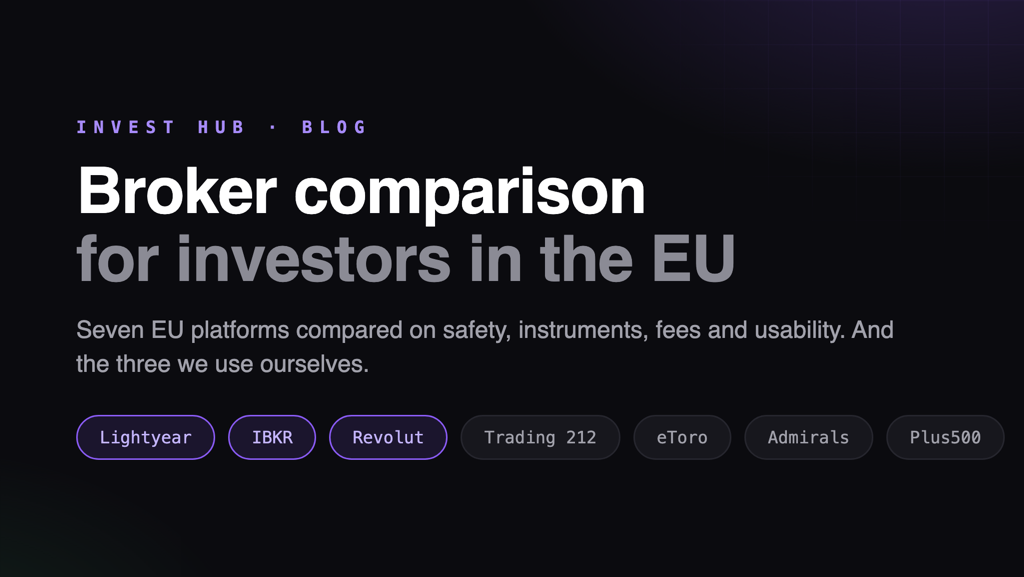
We often get asked which platforms we trade through — especially after trade screenshots from one venue or another (we use several). We broke down seven brokers popular in the EU across four links: safety, instruments, fees, and convenience.
The Short Answer
For those who came for the bottom line. Why exactly these — step by step below.
- Lightyear — for getting started: simple, transparent, EU-licensed. Enough for your first portfolios of stocks and ETFs.
- IBKR — for professionals: options, futures, bonds, a multi-currency account, and the lowest conversion cost.
- Revolut — all in one: investments alongside your everyday finances.
S Is for Safety
Choosing a broker is a mechanism made of several links. Remove one — and the mechanism won’t run. But the links are not equal: the first thing we look at is whether you can answer the question “what happens if the broker goes bankrupt?”
There are two different protection mechanisms here, and they are often confused. Segregation: a licensed broker must keep your securities separate from its own money. In a bankruptcy they don’t fall into the insolvency estate — the portfolio moves to another broker. The compensation scheme kicks in in the bad scenario, when assets have “gone missing”: in the EU it covers up to €20,000 per investor.
Who’s in the Lineup
The European Union has more than 60 licensed brokers — and that’s not counting local banks. We picked the seven that come up most often in questions from club residents: Lightyear, IBKR, Revolut, Trading 212, eToro, Admirals, and Plus500.
Instruments
The market is many-sided, but your starting point should be your own needs, not the length of an asset list. If the goal is to buy stocks and ETFs for the long haul, almost any broker in the sample will do. If you need options, bonds, and futures — the choice narrows sharply. And there’s a separate trap — CFDs: you may think you bought an Apple share, when in fact you hold a contract on its price, often with leverage on top.
Fees and Hidden Costs
The most underrated factor. Beginners look at the tip of the iceberg — the trade commission, which brokers love to set to zero. The real costs hide below the waterline: the spread, currency conversion, withdrawals, inactivity fees.
A good example of a hidden line item is currency conversion. You fund the account in euros, while US stocks trade in dollars — so every trade gets converted:
The difference looks like pennies, but over the long run these are different orders of magnitude: on €10,000 of annual turnover, conversion costs roughly €3 at IBKR and up to €300 at eToro. So before choosing, answer three questions honestly:
- How often do I plan to trade?
- Which instruments?
- In which currency do I hold my assets?
Rare trades and a long horizon — look at custody and inactivity fees. Active options and futures trading — IBKR will be the optimal choice.
Convenience
However cheap a broker may be, if the interface “gets in your way” — you’ve picked the wrong broker. This link is subjective but critical, and it has a price: simplicity almost always means fewer capabilities.
Conclusions
Each has its strengths. The three we use in our day-to-day routine are at the top of the list.
- Lightyear — optimal for beginners: simple, transparent, EU-licensed.
- Revolut — for those who want to combine investing with everyday finances.
- IBKR — the best choice for professionals: options, futures, a multi-currency portfolio.
- Trading 212 — a balance of simplicity and functionality for active investors.
- eToro — social trading and strategy copying; keep track of what is a share and what is a CFD.
- Admirals — versatile, but closer to a forex audience; you will have to study its fee schedules very carefully.
- Plus500 — a platform for trading CFDs, not for owning assets.
Choosing a broker is not a search for the perfect option — it is finding a partner that fits your style. Some care about a simple app and €20,000 of coverage; others about intricate spreads and direct access to US ETFs. What matters is understanding what exactly you want from a broker — and remembering that safety and transparency always rank above promised “zero fees.”
If this was useful — in the Invest Hub club we show our real portfolios and trades, including through the brokers from this article. You can join via the link here.
This material is for information purposes only and is not investment advice. Fees and terms are based on brokers’ public price lists as of August 2026; check the current conditions before opening an account.