Lightyear Review: An Estonian Broker for Starting Out in Investing
mr.ilkevich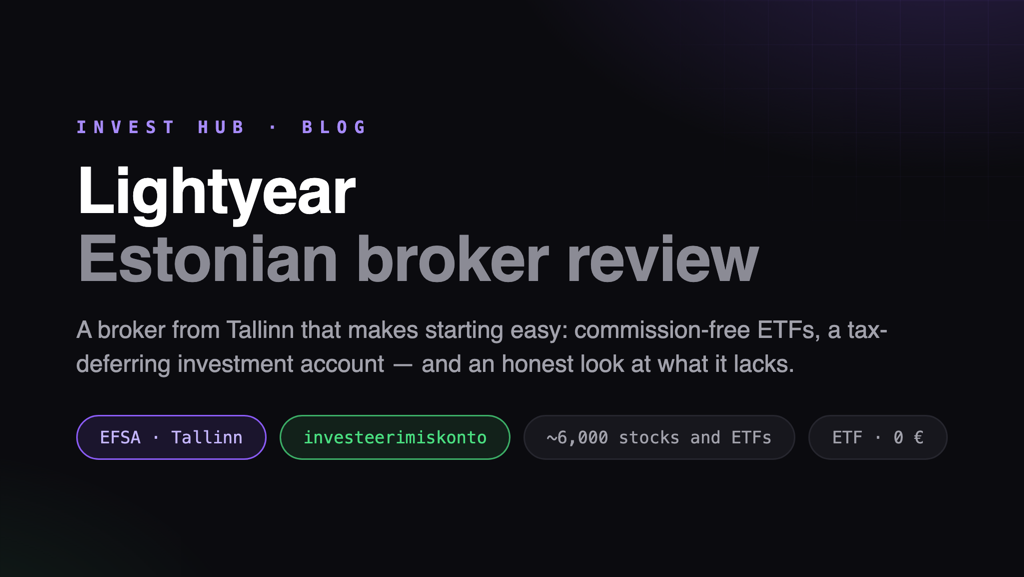
In our broker comparison, Lightyear took the “best for starting out: simple, transparent, EU-licensed” spot — and that is the verdict we are asked to expand on most often. All the more so because this broker is not abstractly European but literally ours: the licence and the office are in Tallinn. We will go through our usual checklist: where your money is held, what you can buy, what it costs — and what Lightyear does not have, so you don’t find out after moving your portfolio.
The Short Answer
- Lightyear is a good fit if you are just starting out: your first stocks and ETFs, a clear app, commissions from $0.10 — and for Estonian tax residents, an investment account with tax deferral and automatic reporting to EMTA.
- Lightyear is not for you if you need options, futures, or bonds — it doesn’t offer them and won’t in the foreseeable future. Outgrown stocks and ETFs? See our IBKR review.
- For EU residents, an account opens from the app in about ten minutes. Residents of Russia and Belarus cannot open an account — same as with any EU broker.
What Is Lightyear
Lightyear was launched in 2021 by two Estonians from the Wise team — Martin Sokk and Mihkel Aamer. The idea was the same as Wise had with transfers: take a service banks charge ten times more for than it costs, and make it fair. The company is young — and we will honestly file that under risks below — but it is structured like a grown-up: Lightyear Europe AS operates under a licence from the Estonian financial supervisor (Finantsinspektsioon) covering the entire EU and EEA.
Where Your Money Is: Tallinn, Not an Offshore
Our first question for any broker never changes: “what happens if it goes bankrupt?” Lightyear’s answer is shorter than most — because the regulator is local. Accounts are held by Lightyear Europe AS under Finantsinspektsioon supervision, securities are segregated from the company’s own money, and for the bad scenario there is the Estonian investor protection fund — up to €20,000 per investor, the same limit as across the EU.
One detail worth understanding: US securities are physically held by a partner — Alpaca, a US custodian and SIPC member. Clients’ uninvested cash sits separately from the company’s money in European banks and in BlackRock and J.P. Morgan money market funds. Multi-layered — but every layer is regulated, and that is exactly the structure we want to see.
What You Can Buy — and What You Can’t
Around six thousand instruments: US, European, and Baltic stocks, a wide range of UCITS ETFs with no trading or custody fees, money market funds for parking spare cash (the rate floats with euro rates — around 2% per year on EUR as of summer 2026), and fractional shares: you can buy a €10 slice of Apple instead of a whole share for two hundred. Multi-currency is covered — euros and dollars live side by side in the account.
Now, honestly, what is missing: options, futures, bonds, and forex. For a beginner that is protection from yourself rather than a limitation — but if your strategy grows into selling covered calls or building a bond ladder, you will need a second account. And the usual EU reminder: US-domiciled ETFs cannot be bought here — the PRIIPs regulation applies to all European brokers alike, so use UCITS equivalents.
Fees
The fee schedule fits in one paragraph — a compliment in itself. There are three paid items: US stocks — 0.1% per trade (minimum $0.10, maximum $1), euro-denominated stocks — €1 per trade, currency conversion — 0.35% at the interbank rate. Everything else is zero: account maintenance, ETF trades, custody, bank transfers, inactivity.
The only line item that matters over time is the 0.35% conversion: several times cheaper than the neobanks, but pricier than IBKR with its hundredths of a percent. The recipe is simple: don’t shuttle currency back and forth — convert once and keep the dollar part of your portfolio in dollars.
The Investment Account: The Trump Card for Estonia
For Estonian tax residents, Lightyear has an argument that outweighs half of this review: the account works as an investeerimiskonto — an investment account under Estonian law. Sold at a profit, received dividends, bought again — no tax until you withdraw more from the account than you put in. Compounding works on the full amount, with no annual “payment for success.”
Who Lightyear Won’t Suit
- Traders and options players. No derivatives, no margin trading, no bonds. This is a buy-and-hold broker, and it doesn’t pretend to be anything else.
- Market collectors. The US, Europe, the Baltics — and that’s it. No point looking for the Tokyo exchange or Hong Kong here.
- Those uneasy about its age. The company is five years old versus half a century for IBKR. Segregation and the protection fund close off the main risk, but a track record of crises survived cannot be bought — a broker either has one or doesn’t yet.
How to Open an Account
Easier than at a bank: download the app (or open the web version), pass verification with an ID card or passport, answer a short questionnaire — the whole thing usually takes about ten minutes, with no paperwork and no branch visits. Funding is a regular SEPA transfer from any EU bank; there is no minimum deposit. For Estonian residents, one piece of advice: mark the account as an investeerimiskonto in your tax return for the year you open it — the regime cannot be switched on retroactively.
Conclusions
- Safety — an Estonian EFSA licence, asset segregation, a protection fund covering up to €20,000; US securities held by a regulated US custodian.
- Simplicity — the best onboarding we have seen from any EU broker: from install to first trade in a single evening.
- Costs — ETFs free, stocks from $0.10; the only thing to watch is the 0.35% conversion.
- The trump card — the investeerimiskonto with automatic EMTA reporting: for an investor in Estonia it saves both taxes and the evening before the filing deadline.
- The ceiling — stocks and ETFs. More sophisticated strategies are a job for IBKR.
Our formula from the broker comparison hasn’t changed: start simple, add complexity as you grow. Lightyear is the best first step available in Estonia and the EU: cheap enough not to eat into your returns, and simple enough not to kill your motivation to invest by week two.
If this was useful — in the Invest Hub club we share our real portfolios and trades on the platforms from this article and help residents with their first steps: from choosing a broker to filing the tax return. You can join here.
This material is for information purposes only and does not constitute investment advice. Fees and terms are per Lightyear’s public price lists as of August 2026; check the current terms on the broker’s website before opening an account. Tax matters depend on your personal situation — when in doubt, consult a specialist.