Where to Invest? Biotech – the Science That Is Changing the World
 mr.ilkevich
Biotechnology sits at the intersection of biology and technology: using living organisms to solve practical problems, from drug development to agriculture.
That sounds academic, but look at what the sector has delivered in recent years: mRNA vaccines were developed in months instead of decades, the first approved CRISPR therapy is already treating sickle cell disease – a genetic condition once considered a death sentence – and GLP-1 drugs (yes, Ozempic and Wegovy) have upended the obesity-treatment market and become one of the biggest investment stories of the decade.
This is not science fiction – it is an industry you can invest in. Let’s look at how.
Why is biotech one of the most promising sectors?
Biotechnology was once applied mainly in agriculture and the food industry. The focus has since shifted to medicine: oncology, Alzheimer’s disease, autoimmune disorders, rare genetic diseases.
And the main demand driver is banal and relentless – humanity is aging. The older the world’s population gets, the more the world spends on medicines, and that curve is not reversing. The global biotech market is already valued at more than $1.5 trillion and is growing at double-digit rates.
For me, this is a chance to invest in technologies capable of changing the very nature of human existence – while resting on the most durable demand there is: people’s desire to live longer and healthier.
But first – the rules of the game
Biotech is a sector with a character of its own, and you need to understand it before buying your first share:
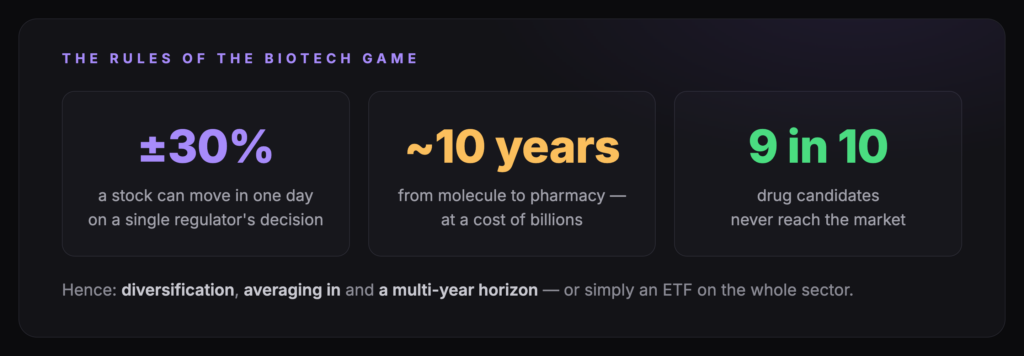
- Binary events. A regulator’s decision to approve or reject a drug can move a stock by tens of percent in a single day – in either direction.
- A long cycle. A drug takes about ten years and billions of dollars to get from molecule to pharmacy, and most candidates never reach the finish line at all.
- Patent cliffs. When a blockbuster’s patent expires, generics eat away the revenue – the company has to keep bringing new drugs to market.
That is why speculating on news here is risky. It makes more sense to treat biotech as a long-term investment, averaging your purchase price over time.
The sector’s largest companies
Hundreds of biotech and pharmaceutical companies trade on the exchanges. Here are a few of the largest players available through Lightyear, Revolut or Interactive Brokers (data as of August 2026; revenue and profit are for fiscal year 2024):
| Ticker | Company | Founded | Share price | Market cap | Revenue | Profit |
|---|---|---|---|---|---|---|
| JNJ | Johnson & Johnson | 1886 | $261 | ≈$630B | $88.8B | $14.1B |
| ABBV | AbbVie | 2013 | $251 | ≈$444B | $56.3B | $4.3B |
| AMGN | Amgen | 1980 | $418 | ≈$224B | $33.4B | $4.1B |
| PFE | Pfizer | 1849 | $27 | ≈$153B | $63.6B | $8.0B |
| BIIB | Biogen | 1978 | $211 | ≈$31B | $9.7B | $1.6B |
What each one is known for:
- Johnson & Johnson (JNJ) – a diversified giant: immunology, neurology, oncology. It has paid and raised its dividend for more than 60 consecutive years.
- AbbVie (ABBV) – the creator of Humira, the best-selling drug in history, which managed to replace it with the new blockbusters Skyrizi and Rinvoq.
- Amgen (AMGN) – a biotech pioneer: oncology, cardiology, rare diseases.
- Pfizer (PFE) – a pharma giant with nearly two centuries of history, known for vaccines and dozens of drugs from Lipitor to Paxlovid.
- Biogen (BIIB) – a specialist in neurodegenerative diseases: multiple sclerosis and one of the first approved therapies against Alzheimer’s disease (Leqembi, together with Eisai).
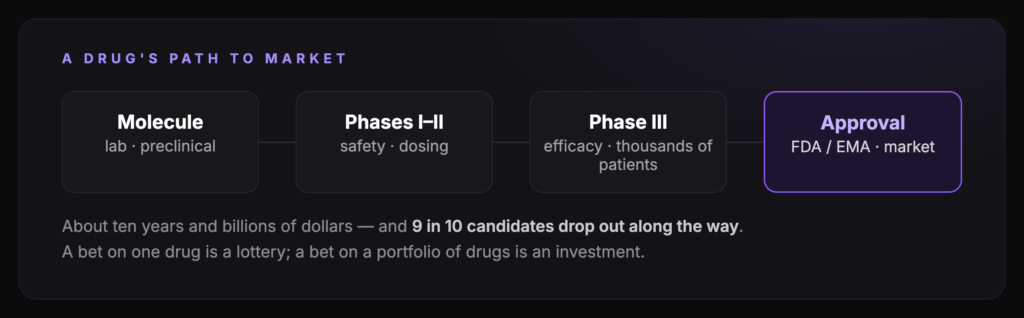
Investing in individual biotech stocks is not for the faint-hearted. The same Biogen can jump 30% in a single day – or fall by the same 30% – on a single regulatory decision. If you buy individual companies, diversify and build your positions in stages.
Don’t want to pick companies? There are ETFs
If you have no desire to dig into dozens of companies, the optimal choice is sector index funds:
- iShares Nasdaq Biotechnology ETF (IBB) – one of the largest biotech ETFs, hundreds of sector companies in a single instrument.
- SPDR S&P Biotech ETF (XBI) – an equal-weighted fund: more weight in smaller companies, with higher potential and higher volatility.
- For a European investor – the UCITS equivalents: iShares Nasdaq US Biotechnology UCITS ETF or the broader Xtrackers MSCI World Health Care UCITS ETF (XDWH), which holds Pfizer, Roche and Johnson & Johnson.
A single fund solves two of the sector’s problems at once: the binary risk of any individual drug is diluted across hundreds of companies, and you don’t have to read clinical studies in the evenings.
My trades in the sector
In our private investors’ club, residents know that I have been actively buying Biogen.

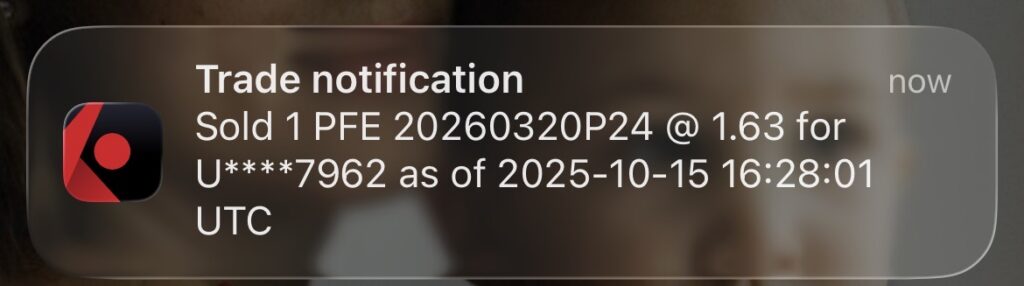
PFE hasn’t been left out either.
Takeaways
- Believe in the sector but don’t want to research companies? ETFs – IBB, XBI or their UCITS equivalents.
- Ready to study individual companies? Start with the giants with diversified drug portfolios – JNJ, AbbVie, Amgen.
- Want more risk and more upside? Smaller companies like Biogen – but only with part of your portfolio and a horizon measured in years.
- Either way – average your purchase price and don’t bet on the outcome of a single clinical trial.
Biotech is a rare combination: a sector that makes the world better while resting on the most reliable demand there is. But the reward goes to the patient – those who invest in the trend rather than speculate on the news.