
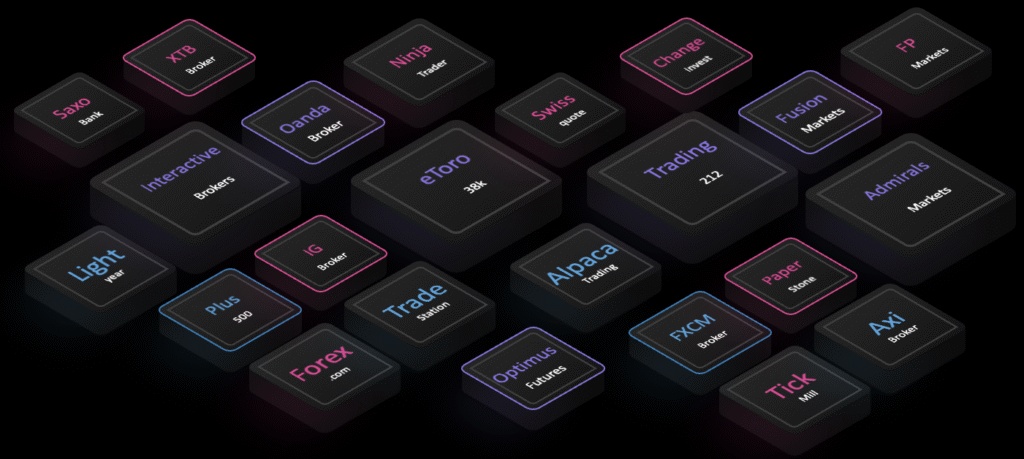
Broker Comparison
We are often asked what platforms we trade through? Especially after publishing our screenshots on one platform or another (we have several). Everyone wants to know the main question: which broker is the most profitable, reliable, and secure?
S is for Security
Choosing a broker can be thought of as an interconnected chain of links that will make your investments work. Without one link or another, as you understand, the mechanism won’t start. There are also links that may play a more important role in the mechanism’s operation.

As you can see, one of the most important elements/links remains security. This is a whole list of various accompanying factors, such as the broker’s reserves, licenses, system protection and operation, as well as investor trust. It’s important that you can answer the question: what happens if it goes bankrupt?


And licenses together with reserves will be just right here. In the European Union, licensed brokers have protection from the regulator of €20,000. This means that if you hold €25,000 with a broker, for example, Lightyear, you receive protection in case of its bankruptcy of €20,000. You should also always consider aspects of licensing and protection in case of force majeure.
The regulator acts as a kind of additional protection for you, requires client assets to be kept separate from broker funds, and eliminates conflicts of interest.
Getting Bored? Let’s Start with the Aces
If you’ve read this far, you’re already a hero. You probably need answers to your questions. So which broker is the coolest? There are over 60 in the European Union, not counting local banks. Let’s show our preliminary analysis, which we wanted to break down at the end, but for now, you probably want to know which ones are in our selection.

Without going into details yet, let’s summarize only the important things. Our selection includes: Lightyear, Revolut, IBKR, Plus500, eToro, Admirals, Trading 212. For now, let’s move on to the next link — instruments.
Instruments
The financial market is multifaceted and has a wide range of assets that can be traded. Some brokers will have simpler assets available, others more complex. What matters is what you need yourself. Trading on eToro, you won’t be trading stocks, but derivative instruments in the form of CFDs, while you might think you bought Apple shares? Professionals need more than just stock trading — they need additional instruments and assets like options, bonds, and specialized leveraged index funds. So you should start from what your needs are. If you just need stock trading, all the above-mentioned brokers may be suitable except eToro, but if you have preferences for other assets, you need to look into it.

Commissions and Hidden Costs
When it comes to trading, one of the most underestimated factors is commissions. Often beginner investors only look at the visible part of the iceberg — the trade commission. But the real costs are hidden deeper. This includes the spread (difference between buying and selling), currency conversion fees, and fees for withdrawal or inactivity.
For example, Revolut and Lightyear offer zero commissions or for the first few trades per month, but with active trading, these benefits quickly run out. IBKR, on the other hand, is known for its transparency and low commissions for professionals, but beginners may find its interface too complex. eToro adds hidden costs to the spread, and CFD instruments can carry increased risks when using leverage.
Therefore, when choosing a broker, you should ask yourself three simple questions:
- How often do I plan to trade?
- What instruments will I use?
- What currency do I hold assets in?
If you trade rarely and prefer long-term investments, low storage fees and no inactivity charges are more important. But if you actively trade options or futures — IBKR will be the optimal choice.
Convenience and User Experience
No matter how profitable a broker is, if you can’t figure out the interface — there’s little use for it. Revolut and Lightyear win due to simplicity: you can buy stocks right from the app in a couple of clicks. Trading 212 also wins with convenience and modern design.
However, professional brokers like IBKR have an overloaded interface — but the capabilities are much wider. You can build complex options, create automated strategies, and connect third-party analytical services.
The question of convenience is subjective but critical: if you feel the system is “getting in your way,” it means you’ve chosen the wrong broker.
Conclusions
Each has its strengths and weaknesses, but our top three is presented in TOP 3, which we actively use in our daily routine.
- Lightyear — optimal for beginner investors, simple, transparent, and licensed in the EU.
- Revolut — suitable for those who want to combine investing and daily finances.
- IBKR — the best choice for professionals, especially if you trade options, futures, or hold a multi-currency portfolio.
- Trading 212 — a balance between simplicity and functionality, suitable for active investors.
- eToro — more suitable for social trading and copying strategies.
- Admirals — universal, but closer to the forex audience. Commissions are hidden and non-transparent.
- Plus500 — a platform for CFD trading, but not for owning assets.
Choosing a broker is not about finding the perfect option, but selecting a partner for your trading style. Some people want a simple app and €20,000 insurance, while others want the ability to set up a complex spread or buy an American ETF directly.
The main thing is to understand what exactly you want from a broker, and remember: security and transparency should always be above promised “zero commissions.”
Enjoyed the article?
Join our investment club Invest Hub. We’ll open up a new world of investing and capital growth for you. You can join here

![On the Way to $1M - 8% Complete [Dec.25]](https://investhub.ee/wp-content/uploads/2026/01/Gemini_Generated_Image_y1z8j6y1z8j6y1z8-300x300.webp)
![Monthly Portfolio Review [Nov.25]](https://investhub.ee/wp-content/uploads/2025/11/AlexPortfolio-1-300x150.png)
![On the Way to $1M - 4% Complete [Nov.25]](https://investhub.ee/wp-content/uploads/2025/12/Gemini_Generated_Image_nntcs1nntcs1nntc-300x300.webp)