Interactive Brokers (IBKR): An Honest Review for the European Investor
mr.ilkevich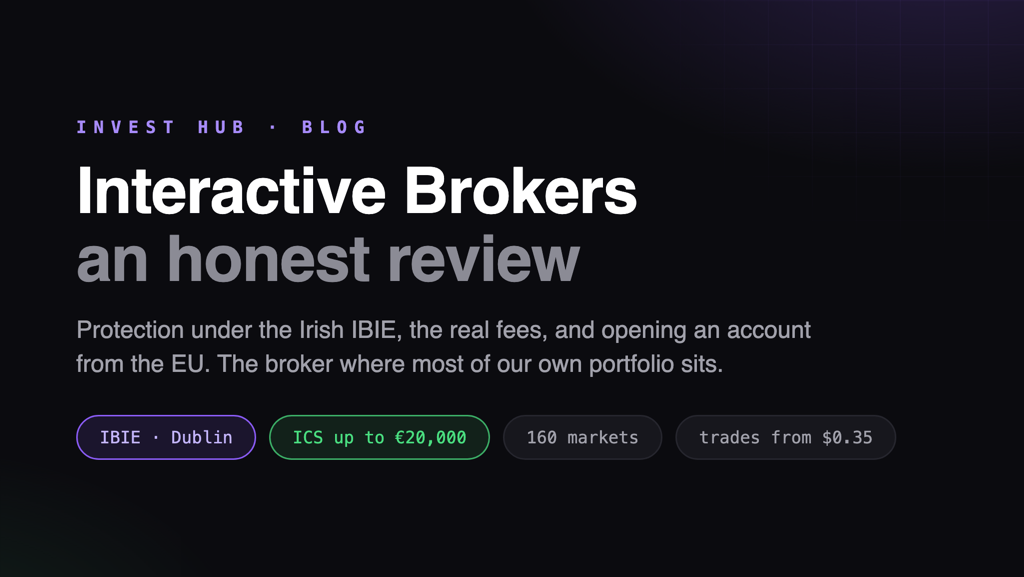
Of all the platforms we trade through, Interactive Brokers raises the most questions: “isn’t it complicated?”, “what happens to my money if something goes wrong?”. Fair questions — at first glance, IBKR really is not the friendliest broker out there. Yet it is where we keep most of our portfolio, and in this article we explain why: asset protection, real fees, the pitfalls, and a step-by-step guide to opening an account from the EU.
The Short Answer
- IBKR is a good fit if you are building a long-term portfolio of stocks and ETFs, want a multi-currency account and the lowest costs in the EU — or if you need options, futures and bonds.
- IBKR is not for you if you want a “three-button app” and are willing to pay for simplicity. The interface will annoy you for the first week.
- For EU residents the account opens online within a few days, with no minimum deposit. Residents of Russia and Belarus cannot open an account — more on that, honestly and in detail, below.
What Is IBKR
Interactive Brokers is an American broker founded by Thomas Peterffy in 1978. It is not a venture-funded fintech startup but a public company whose shares trade on NASDAQ under the ticker IBKR — meaning anyone can inspect its financials, capital and resilience. For us that is the first filter: a broker that will survive a crisis matters more than a broker with a pretty onboarding.
Where Your Money Sits: IBIE and Asset Protection
The first question to ask any broker — “what happens if it goes bankrupt?” — is one we already raised in our broker comparison. At IBKR the answer works like this: clients from the EU and EEA are served by the Irish entity Interactive Brokers Ireland Limited (IBIE), supervised by the Central Bank of Ireland. Since 2024 it has been the single “window” for all of Europe — the Hungarian unit was merged into the Irish one.
From there, two familiar mechanisms apply. Segregation: your securities are held separately from the broker’s own money and do not fall into the bankruptcy estate. The compensation scheme — the Irish ICS — kicks in under the bad scenario and reimburses 90% of a claim, capped at €20,000 per investor. That is the standard European limit, and the standard conclusion follows: capital well above the limit is best kept on more than one platform.
What You Can Buy
Here IBKR plays in a different league from the neobanks: stocks and ETFs on 160 markets, options, futures, bonds, the currency market, fractional shares. The account is multi-currency — you can hold euros and dollars at the same time and convert only when it suits you, not the broker.
One important detail for EU residents that the ads never mention: you cannot buy US-domiciled ETFs — and that is not an IBKR restriction but the European PRIIPs regulation, which requires a KID document from the fund. The rule is the same for every EU broker. The standard workaround: UCITS versions of the same indices — instead of the American S&P 500 fund you buy its Irish twin (for example, VUAA or CSPX), often with a dividend tax advantage on top.
Fees: What You Pay For — and What You Don’t
Fees are the main reason professionals forgive IBKR its interface. There is no minimum deposit, no inactivity fee, and no charge for holding stocks. On idle cash above a threshold the broker pays interest. In practice you pay for two things: trades and currency conversion.
Currency conversion is the “hidden” line item where IBKR beats the competition by an order of magnitude: hundredths of a percent versus 0.5–1.5% at the neobanks. On a €10,000 annual volume that is the difference between ~€3 and hundreds of euros — see the detailed breakdown with the fee iceberg in our broker comparison.
Who IBKR Is Not For
We promised an honest review, so no curtsies.
- The interface is overloaded. Client Portal has become much better than it was five years ago, but it is still a tool, not a toy. You will find the “buy” button easily; the dividend report will take you a good twenty minutes the first time.
- Taxes are your job. IBKR does not withhold tax on your gains automatically the way a local bank does: once a year you take the annual statement and declare the income yourself. For Estonia the procedure is simple, but it exists.
- Nobody holds your hand. No account manager, no “investment ideas”, no “how are you doing” calls. For us that is a plus — a broker should execute trades, not sell products — but if you are used to bank-style service it will take getting used to.
If after this list you want something simpler — look at Lightyear or Revolut from our comparison: for a first ETF portfolio they are enough. You can always come to IBKR later, once your portfolio and your requirements grow.
How to Open an Account: Five Steps
Practical details that save time. Enter your data exactly as it appears in your documents — a one-letter transliteration mismatch means a manual review and extra days. Don’t embellish the experience questionnaire: your answers determine which instruments you get access to, but options can be enabled later in the settings. A SEPA transfer from any EU bank usually arrives within a day; make your first trade a small one — simply to go through the full cycle and see how the fee is calculated.
Conclusions
- Reliability — a public company with almost half a century of history; European clients’ accounts sit with the Irish IBIE under Central Bank of Ireland supervision, with segregation and the ICS scheme up to €20,000.
- Costs — the lowest we have seen in practice: no account or inactivity fees, conversion at hundredths of a percent.
- Instruments — everything a long-term investor or a trader needs: from UCITS ETFs to options and bonds.
- The price you pay — time to learn the interface and a do-it-yourself tax return once a year.
IBKR is a broker you choose with a calculator, not with your heart. You won’t like it for the first week, and after a month you will stop noticing it — and an unnoticeable broker with low costs is exactly what a portfolio needs over a horizon of decades.
If this was useful — in the Invest Hub club we show our real portfolios and trades, most of which go through IBKR, and we help residents at every step — from opening an account to the annual tax return. You can join via the link here.
This material is for information purposes only and does not constitute investment advice. Fees and terms are taken from Interactive Brokers’ public price lists as of August 2026; check the current terms on the broker’s website before opening an account.